Solid vs. Perforated Drain Pipe: Which Does Your Bay Area Property Need?
If water is showing up where it shouldn't, the fix usually comes down to two pipe types working together, not one pipe type winning out over the other. Solid drain pipe is built to carry water that has already been collected to a discharge point. Perforated pipe is built to collect water from the surrounding soil in the first place. Many Bay Area properties end up needing both: a perforated collector tied into a solid outlet line that carries the water away. The right combination depends on where the water is coming from, how much slope is available, and whether there's a suitable place for that water to go.
What Solid and Perforated Pipe Actually Do
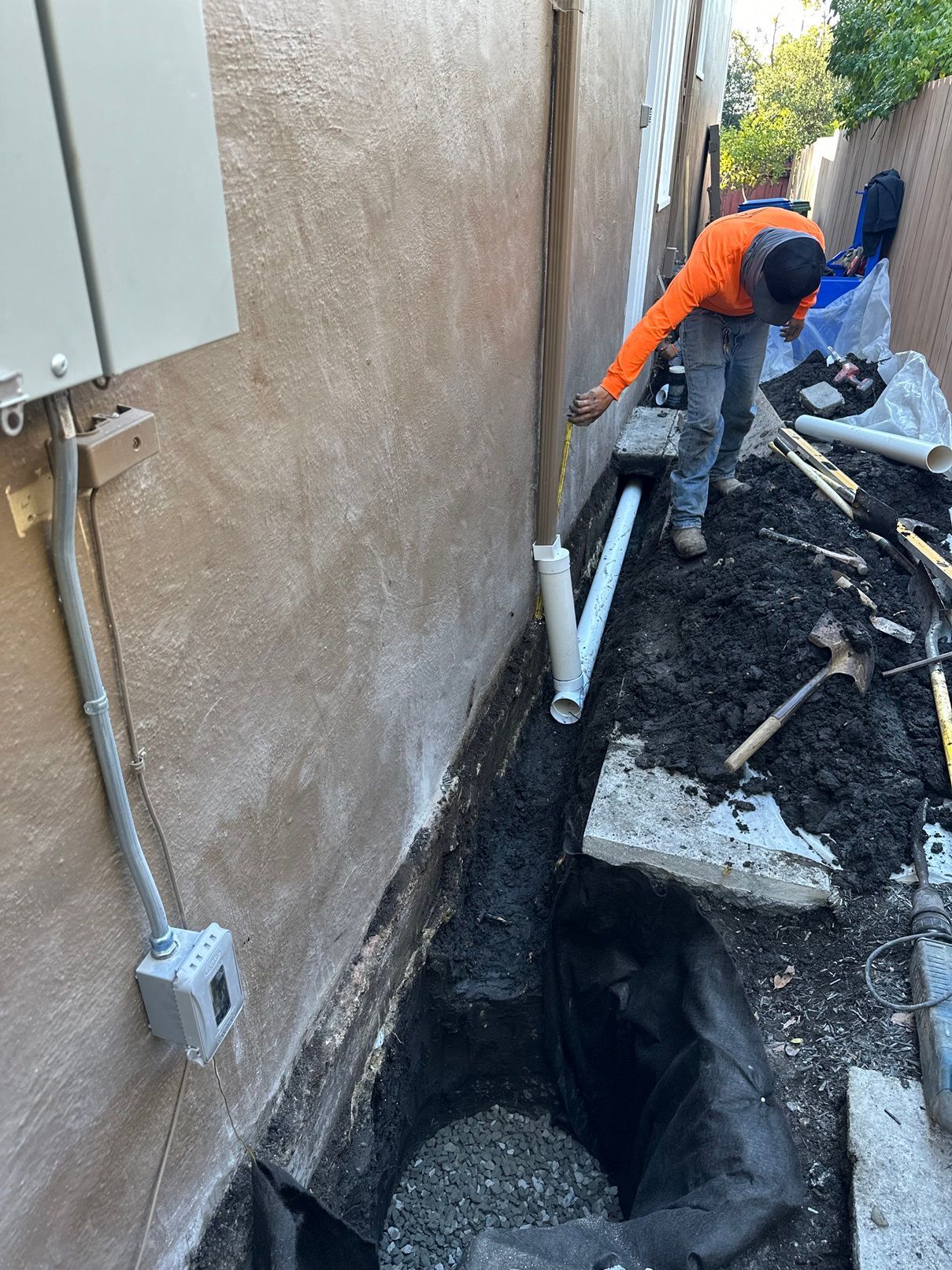
It helps to think of these as two different jobs rather than two competing products. A perforated pipe has openings along its length so groundwater can enter from the surrounding soil, which is why it's used to collect water from a wet area. A solid pipe has no openings, so it's used once water has already been gathered and simply needs to travel, without leaking back into the ground, to a discharge point like a street drain, dry well, or daylight outlet.
| Pipe Type | Primary Job | Typical Role in a Drainage System |
|---|---|---|
| Perforated pipe | Collects water from surrounding soil | Used along the wet area or foundation edge to intercept groundwater |
| Solid pipe | Conveys already-collected water | Carries water from the collection point to a discharge location |
A common mistake is assuming the openings tell you everything about the pipe. They don't. Advanced Drainage Systems' product catalog shows that corrugated HDPE pipe is manufactured in both perforated and non-perforated versions, so the presence of holes is a separate question from the pipe's material and wall construction. In other words, non-perforated doesn't automatically mean rigid PVC, and perforated doesn't automatically mean a flexible corrugated tube. The function (collecting vs. conveying) is what should drive the choice, not assumptions about the material.
Before You Blame the Pipe, Find the Real Source
A wet basement or damp crawlspace doesn't automatically mean a buried drain has failed. Several other sources are worth ruling out first:
- Gutters and downspouts that aren't carrying roof water far enough from the foundation
- Plumbing leaks inside or near the affected area
- Gaps or openings in the foundation wall
- Grading that slopes water toward the house instead of away from it
According to the Pacific Northwest National Laboratory's guidance on footing drain pipe, these common causes should be investigated before assuming the solution is a full drainage replacement. Once the actual water source is clear, it's much easier to decide whether the property needs a new perforated collector, a solid conveyance line, or both.
The Pipe Is Only Part of the System
Even the right pipe can underperform if the surrounding system isn't built to support it. A conventional footing drain assembly relies on washed stone and filtration fabric to keep fine sediment away from the collector pipe. If the surrounding gravel isn't clean, those fines can work their way into the perforations over time and reduce how well the pipe drains. This is why pipe selection alone can't compensate for an assembly that wasn't put together correctly in the first place.
Outlet feasibility matters just as much. A perforated collector is only useful if the water it gathers has somewhere to go. When the site doesn't have enough slope or elevation for gravity to carry water to a discharge point, draining into a sump pit for pumping is an option worth discussing rather than assuming gravity discharge is the only path.
Local Considerations for Berkeley and Oakland Properties
Cardona Construction serves homeowners in Berkeley, Oakland, and the surrounding Bay Area, where clay-rich soils, hillside lots, and challenging drainage conditions can influence the design of a water management system. Each property needs to be evaluated based on its specific slope, soil conditions, and available drainage outlets.
Where a project involves connecting to a public storm drain, it's worth knowing that the City of Berkeley requires a sewer and storm drain permit for installing, relocating, repairing, or replacing storm drains within the public right-of-way. An available street drain nearby isn't the same thing as automatic permission to tie into it. Cardona Construction can evaluate your property's drainage needs and help identify what engineering coordination or permitting requirements should be discussed before work begins.
Let Cardona Construction Help You Choose the Right System
Every property's water problem is a little different, and the right answer is often a combination rather than a single pipe type. Cardona Construction offers Solid Drain Lines, French Drain Installation, Subsurface Drains, Foundation Footing Drains, Catch Basin & Channel Drain Installation, Sump Pump & Battery Backup System Installation, and Trenching, so a system can be built around what your property actually needs rather than a one-size-fits-all fix. You can also review our Solid Drain Lines page for more on the conveyance side of a drainage system.
Cardona Construction is a licensed (Lic #1100158), insured, and bonded family-owned contractor with over 40 years of combined experience serving Berkeley, Oakland, and the surrounding Bay Area. Our team can take a look at your property and help you decide what's actually needed. Call (925) 642-6349 to talk through your drainage situation.