Foundation Replacement vs. Seismic Retrofitting: Which Does Your Bay Area Home Need?
Foundation Replacement vs. Seismic Retrofitting: Which Does Your Bay Area Home Need?
If you have noticed cracking, settling, or shifting around your foundation, it is natural to wonder whether the fix is a full foundation replacement or a seismic retrofit. These are two different repairs for two different problems. Foundation replacement addresses damaged or deteriorated foundation material itself, while seismic retrofitting strengthens the connection between your home's framing and its existing foundation so the structure performs better during an earthquake. Which one your home needs depends on the condition of the foundation and how your house is built, not simply its age. In many cases, the right answer is a combination of the two rather than an either/or choice.
Cardona Construction works on foundation repair and foundation replacement projects throughout Berkeley, our primary service area, and Oakland, where we also handle drainage and foundation work. Here is how to think through the decision before committing to a scope of work.
Two Different Problems, Two Different Fixes
Foundation replacement and foundation repair are among our core services, and it helps to understand what each one actually solves. Foundation replacement deals with the foundation material itself when it has deteriorated, cracked extensively, or can no longer reliably support the structure. Seismic retrofitting is different: it reinforces how your home's framing is attached to the foundation so the two move together during ground shaking instead of separating.
Our foundation repair services cover seismic retrofitting through bolting and bracing, along with partial foundation replacement and underpinning for sections that need targeted reinforcement. That means a home does not always face a choice between replacing everything and doing nothing. Often the right scope falls somewhere in between.
Why a Single Crack or an Older Home Should Not Decide the Scope
It is tempting to assume that an older home or a visible crack automatically means full replacement is necessary. FEMA's guidance on seismic retrofitting points to a more precise standard: what matters most is foundation stability and whether retrofit anchors can be reliably attached to sound material. Visible deterioration is worth a closer look, but a crack by itself does not establish that full replacement is the only answer (FEMA P-1100).
This is echoed in the assessment guidance published by the California Residential Mitigation Program, which calls for damaged or weakened foundation sections to be addressed before retrofit work begins, with professional design brought in for more extensive problems. Where a foundation is made of unsuitable masonry, strengthening or replacement of that section may be the right response, rather than a blanket decision for the whole house. The takeaway: a proper assessment, not a visual guess, should determine whether you are looking at repair, retrofit, replacement, or some combination of the three.
What a Seismic Retrofit Actually Involves
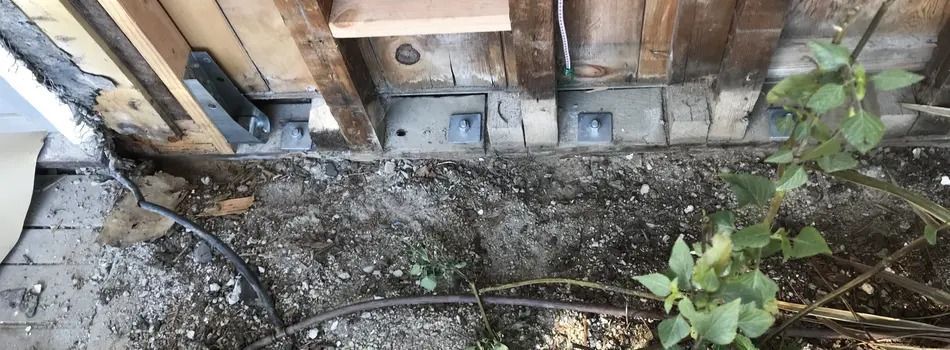
For raised wood-frame homes, a typical seismic retrofit is often described as a brace-and-bolt approach:
- Anchors or foundation plates connect the home's wood framing securely to the concrete foundation
- Short cripple walls, the short wall sections between the foundation and the first floor, are strengthened with plywood or OSB bracing
- Where the framing already sits directly on the foundation rather than on cripple walls, a bolt-only retrofit may be enough, without the bracing step
Which version applies comes down to how your particular home is built, which is part of why a site visit matters more than a general rule of thumb.
When Repair, Retrofit, and Replacement Work Together
Many Bay Area homes do not need a single, all-or-nothing fix. A home might need a damaged foundation section repaired or partially replaced, paired with seismic retrofitting for the rest of the structure. Our team coordinates engineering referrals and handles permit submissions directly as part of this process, and when a section is replaced, we use Grade 60 steel reinforcement and integrated waterproofing. Combining these pieces into one coordinated plan, rather than tackling them as separate projects, helps keep the scope matched to what the house actually needs.
How Your Home's Construction Changes the Right Approach
The construction type of your house has a real effect on what kind of work applies. The California Earthquake Authority identifies several distinct vulnerability categories that call for different considerations, including raised perimeter foundations, homes with living space built over a garage, post-and-pier construction, and homes built on hillside lots. A standard crawl-space bolting plan is not a complete answer for every one of these configurations.
It is also worth knowing that not every retrofit requires custom, individually stamped engineering. According to the California Residential Mitigation Program, many qualifying retrofits can use locally accepted standard plans. More complex houses, steep hillside construction, large lower-level openings, or serious foundation and drainage problems may require engineered plans instead, and permit and inspection requirements should always be confirmed with your local building department.
What Drives Cost and Scope in a Full Replacement
When a full foundation replacement is genuinely the right call, the scope typically involves several coordinated steps:
- Temporary support of the structure while work is underway
- Demolition of the damaged foundation sections
- Excavation around the perimeter
- Forming and pouring new footings and foundation walls
- Curing time before the load is transferred back onto the new foundation
Perimeter length, depth required, soil conditions, site access, and the complexity of temporary support all affect the final scope. That is also why comparing a full replacement estimate to a simple bolting-only retrofit is not an apples-to-apples comparison. They are different projects solving different problems, even when a homeowner is weighing them side by side.
Local Conditions in Berkeley and Oakland
Where your home sits in the Bay Area adds another layer to the decision. In Berkeley, our primary service area, expansive clay soils and regional seismic risk are common factors in foundation repair and replacement work. Expansive soil behavior depends on the clay's mineral composition and how much its moisture content changes over time, and concentrated drainage discharge near a foundation can contribute to that swelling. In Oakland, where we also handle drainage and foundation projects, hillside lot conditions and water management tend to be the more pressing considerations. These are separate issues from the earthquake-connection problem that a seismic retrofit addresses, which is why a thorough assessment needs to look at both soil and moisture conditions and structural attachment, not just one or the other.
Get a Clear Answer for Your Home
The only reliable way to know whether your home needs foundation replacement, seismic retrofitting, or a combination of both is a proper on-site assessment. Cardona Construction offers a free on-site foundation inspection and free estimate, and all of our foundation work is backed by a 30-year warranty. We serve Berkeley as our primary market and Oakland as a secondary service area, along with the surrounding Bay Area.
Call (925) 642-6349 to schedule your free foundation inspection and get a clear recommendation for your Berkeley or Oakland home.